
Published by Freedom Industrial Works
Modern Glock reset systems are some of the most geometry-sensitive trigger mechanisms in the firearm industry today. Unlike AR-platform reset systems that interact with a bolt carrier group, Glock-based systems must work within an extremely compact striker-fired operating system where timing, leverage, and mechanical interaction all happen within milliseconds.
That challenge is exactly what makes Glock trigger geometry so interesting.
At Freedom Industrial Works, we spend a significant amount of time studying:
- reset timing,
- trigger leverage,
- barrel unlocking geometry,
- contact surfaces,
- and force transfer characteristics inside Glock-pattern systems.
This article breaks down the core mechanics behind Glock-style reset systems and explains how barrel movement during cycling interacts with trigger reset geometry.
Understanding the Glock Locking System
Glock pistols use a short-recoil, tilting-barrel operating system.
When the pistol fires:
- the slide and barrel initially move rearward together,
- the locking geometry then cams the rear of the barrel downward,
- the barrel unlocks from the slide,
- and the slide continues rearward independently.
As the rear of the barrel drops during unlocking, the front of the barrel appears to tilt upward relative to the frame.
This movement creates a repeatable mechanical motion inside the pistol that can be used as a timing event for reset-assist systems.
During cycling, several components move relative to each other:
- trigger bar,
- connector,
- slide,
- barrel,
- locking block,
- and striker system.
Modern reset systems are designed around carefully timing interaction with this movement.
Why Barrel Unlocking Geometry Matters
The key to understanding Glock reset systems is realizing that the pistol already contains a precisely timed sequence of mechanical movement.
Nothing extra needs to be added to create motion.
The movement already exists naturally during recoil:
- slide travel,
- barrel unlocking,
- connector movement,
- trigger bar displacement,
- and striker reset.
A reset-assist system simply uses carefully designed geometry to interact with that movement during the operating cycle.
In many modern systems, the barrel unlocking motion itself becomes part of the reset timing mechanism.
How the FRT Shoe Hook Works
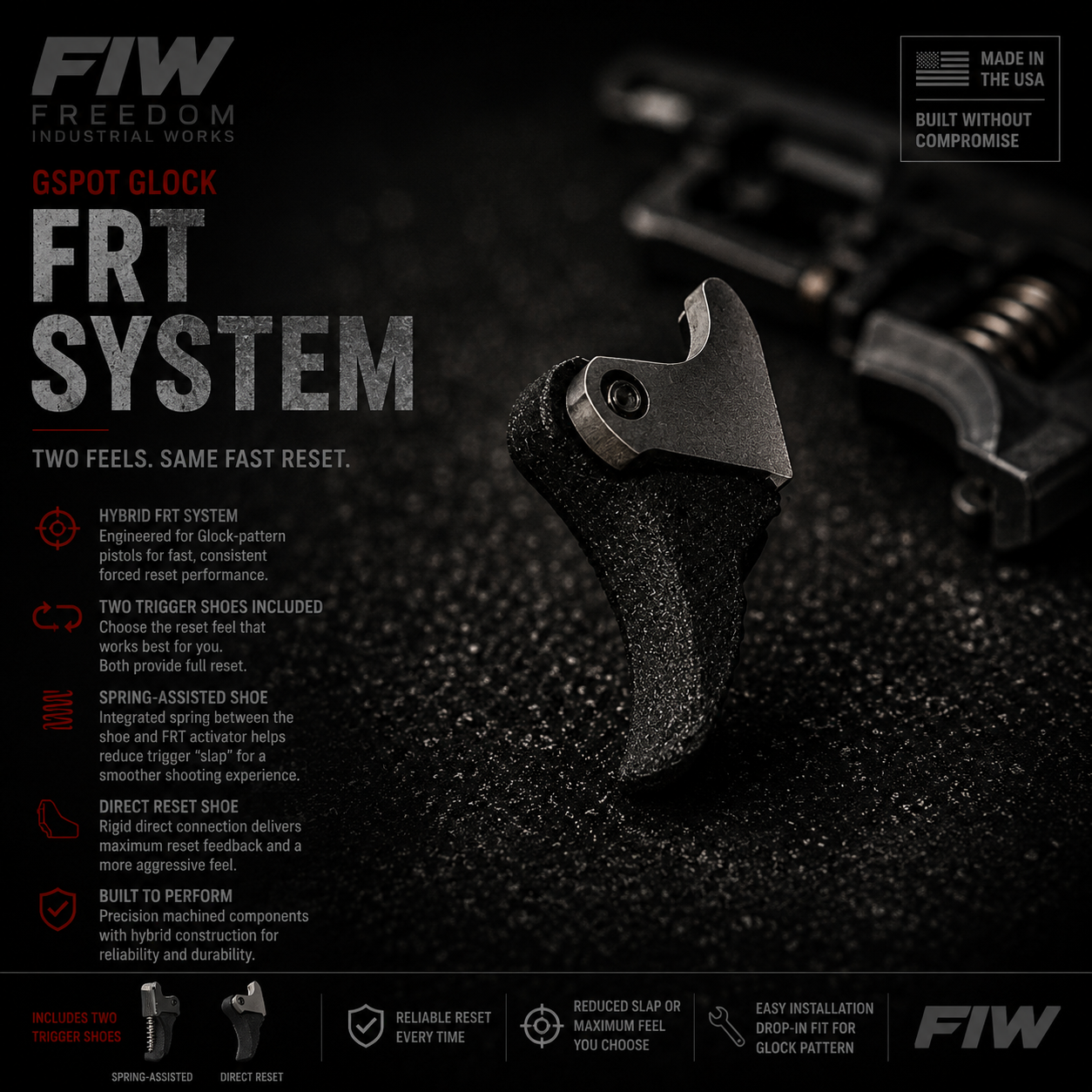
In Glock reset-assist systems, the trigger shoe geometry can include an engagement surface or hook positioned to interact with the barrel and locking geometry during cycling.
As the pistol unlocks and the rear of the barrel cams downward:
- the engagement surface contacts the reset geometry,
- force is transferred into the trigger system,
- and the trigger is mechanically driven back toward reset.
The important detail is that the system uses motion that already naturally exists within the Glock operating cycle.
The reset mechanism is essentially timing mechanical interaction around the barrel unlocking sequence.
Why Timing Is So Critical in Glock Platforms
Compared to AR-pattern rifles, Glock pistols have extremely limited internal space.
That means:
- smaller timing windows,
- tighter tolerances,
- shorter travel distances,
- and much faster interaction speeds.
Tiny geometry changes can dramatically affect:
- reset feel,
- trigger consistency,
- contact force,
- reliability,
- and cycling behavior.
A few thousandths of an inch can completely change how the system behaves.
That’s why serious trigger development almost always involves:
- repeated prototype revisions,
- live cycling analysis,
- fitment testing,
- and extensive geometry refinement.
Understanding Trigger Slap
One of the most discussed characteristics in reset systems is trigger slap.
Trigger slap occurs when excessive reset energy transfers back into the shooter’s finger during cycling.
In Glock reset systems, this can happen when:
- contact geometry is too aggressive,
- leverage ratios are incorrect,
- reset timing is too abrupt,
- or force transfer is not properly controlled.
The challenge is balancing:
- positive tactile reset,
- reliable operation,
- and shooter comfort.
A system with insufficient reset force may feel weak or inconsistent.
A system with excessive reset force may feel harsh or uncomfortable during rapid cycling.
The ideal setup balances both.
Why Trigger Geometry Matters
Modern trigger systems are fundamentally geometry-driven mechanisms.
Small changes to:
- hook angle,
- engagement depth,
- pivot distance,
- trigger leverage,
- and contact timing
can dramatically alter system behavior.
Even seemingly minor modifications can affect:
- reset speed,
- tactile feel,
- perceived recoil impulse,
- consistency,
- and wear characteristics.
This is why precision machining and dimensional consistency matter so much in advanced trigger systems.
Spring-Assisted vs Rigid Reset Designs
Different systems handle reset force differently.
Rigid Reset Systems
Rigid systems transfer reset force directly through mechanical contact surfaces.
Advantages:
- aggressive tactile reset,
- strong feedback,
- very positive reset feel.
Tradeoffs:
- harsher force transfer,
- increased trigger slap potential,
- more abrupt cycling feel.
Spring-Assisted Systems
Spring-assisted systems introduce a controlled buffer between reset surfaces.
This can help:
- soften reset impulse,
- reduce perceived slap,
- smooth out trigger feel,
- and improve comfort during extended shooting sessions.
Different shooters prefer different characteristics depending on intended use and personal preference.
Hybrid Trigger Construction
One of the most interesting developments in modern trigger systems is hybrid construction.
Instead of relying entirely on either:
- polymer,
or: - steel,
some systems combine:
- stainless steel reinforcement,
- with advanced engineered composites such as carbon fiber filled nylon.
Hybrid construction can provide:
- lower weight,
- reduced vibration transfer,
- manufacturing flexibility,
- and cost efficiency,
while still maintaining critical wear surfaces in steel.
At Freedom Industrial Works, we’ve been heavily focused on balancing:
- geometry consistency,
- durability,
- reset feel,
- and manufacturability.
The result is a growing line of hybrid and stainless reset systems engineered around real-world cycling behavior.
Why Glock Trigger Development Is Difficult
Many people underestimate how difficult Glock trigger development actually is.
Because the platform is so compact internally:
- timing becomes extremely sensitive,
- geometry changes become amplified,
- and tolerance stacking becomes a major factor.
A dimension that barely matters in an AR platform may completely change the behavior of a striker-fired pistol.
That’s why successful systems require:
- extensive testing,
- repeated geometry refinement,
- and careful material selection.
Reliable performance comes from precision, not guesswork.
Frequently Asked Questions
How does a Glock reset-assist system work?
The system uses mechanical interaction during the operating cycle to help drive the trigger back toward reset.
Does the barrel actually move during cycling?
Yes. Glock pistols use a short-recoil tilting-barrel system where the rear of the barrel cams downward during unlocking while the front appears to tilt upward relative to the frame.
Why is trigger geometry important?
Small dimensional changes directly affect:
- timing,
- leverage,
- reset feel,
- force transfer,
- and reliability.
What causes trigger slap?
Trigger slap occurs when excessive reset energy transfers back into the shooter’s trigger finger during cycling.
Why use hybrid trigger systems?
Hybrid systems can balance:
- durability,
- weight reduction,
- vibration damping,
- and manufacturing efficiency.
Final Thoughts
Modern Glock reset systems are fundamentally exercises in precision geometry.
The pistol already contains:
- barrel movement,
- slide travel,
- connector interaction,
- and trigger reset timing.
The challenge is engineering a system that uses those movements consistently while maintaining:
- reliable operation,
- controlled reset force,
- clean timing,
- and repeatable performance.
That’s why serious trigger development requires:
- precision machining,
- repeated testing,
- and deep understanding of mechanical interaction inside striker-fired platforms.
At Freedom Industrial Works, our focus remains the same:
Build cleaner geometry, stronger materials, and more refined reset systems through practical engineering and precision manufacturing.
You can check out our hybrid Glock FRT here:
https://freedomindustrialworks.com/product/glock-frt-g-spot-2-0-shoe-and-reset-hook/
and we will be dropping a stainless one piece FRT next week!
We also have trigger shoe pin removal tools here:
https://freedomindustrialworks.com/product/freedom-industrial-works-2mm-hss-pin-punch-glock-trigger-shoe-removal-tool/
Freedom Industrial Works
Precision Engineered. American Made.
https:www.freedomindustrialworks.com/
Technical articles and updates:
https://freedomindustrialworks.com/blogs/news